PickFresh App
- 4.1
- Rating
- 10.00K
- Installs
- Free
- Price

 Analysis by App-foxy
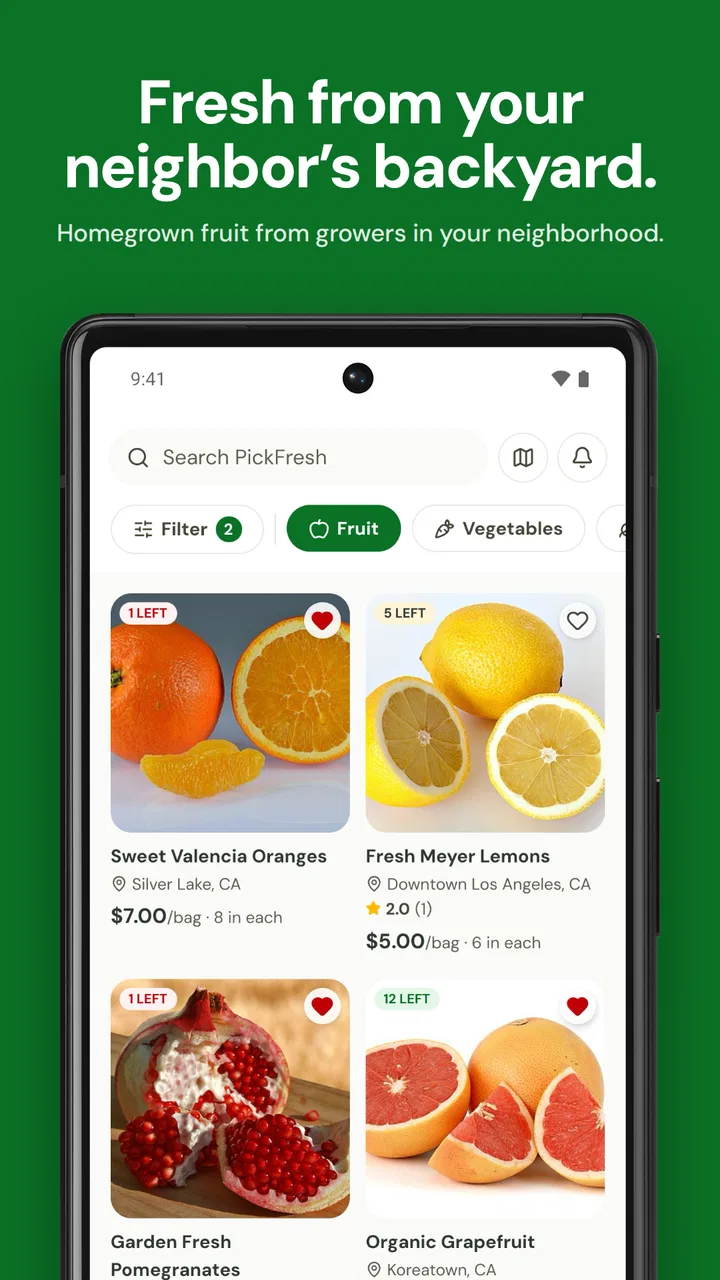
I tried PickFresh App as a shopping app built around local fruit buying, and my first impression was that it aims at a very specific kind of convenience: helping people look for fruit from nearby sellers rather than treating grocery shopping as a purely supermarket-based task. That focus gives it a clearer identity than a general shopping app, but it also means its usefulness depends heavily on whether local fruit options are available where you live.
PickFresh App is developed by PickFresh, Inc. and is free to install. That matters when judging its value: there is no purchase price to recover before you can decide whether it fits your routine. I would describe it as a low-risk app to try, especially for someone already interested in buying local produce. Its store category is Shopping, its content rating is Teen, and it runs on devices using Android 7.0 or later.
The app is still relatively new, having been released on December 21, 2025. Its current version is 1.0.16, and it has passed 10K installs. The average rating is 4.1 from 84 ratings, with 28 written reviews. Those figures suggest that people are engaging with it, while also reminding me not to treat it as a long-established marketplace with years of public feedback behind it.
You May Also Like

 AccuWeather: Weather Radar
AccuWeather Review: A Quick, Clear Forecast for Everyday Decisions
For everyday plans, the best forecast is the one you can understand quickly. AccuWeather makes rain timing, radar, and local conditions easy to act on, with a few trade-offs.

 Hill Climb Racing
Why Hill Climb Racing Still Turns Crashes Into One More Run
A tiny car, a bumpy hill and one more upgrade: Hill Climb Racing keeps resurfacing because its simple chaos makes every near-miss feel personal.

 AliExpress - Shopping App
AliExpress Makes Global Shopping Feel Personal, but Shoppers Bear the Risk
AliExpress turns a global marketplace into a pocket-sized discovery engine. Its reach is useful, its shopping loop compelling, and its trade-offs easy to miss.

 Lords Mobile: Kingdom Wars
Lords Mobile Is a Kingdom-Building Routine, Not a Quick Match
A case-by-case verdict on the building, battles, device demands, and social commitments that make Lords Mobile rewarding for some players and exhausting for others.

 PDF Scanner app - TapScanner
TapScanner Makes Paperwork Easier to Capture, Check, and Share
TapScanner makes scanning with a phone feel less like a rescue operation and more like a dependable step in getting work done. Its capture tools are useful, though not flawless.

 Block Blast!
 Shows How Much a Puzzle Game Can Leave Out
A quiet grid game shows why puzzle players increasingly value instant clarity, repeatable skill and low-pressure play—and where the genre still needs to catch up.
More From Our News Desk
View All News


How PickFresh App fits into everyday fruit shopping
I’d use this section to think about where a local-fruit marketplace belongs in a routine that may already involve a supermarket app, a paper list, or a quick stop at a nearby shop. The useful test is whether checking local options changes a decision you would otherwise make, such as what to cook or when to shop. That distinction helps set realistic expectations before relying on it week after week.
A focused alternative to broad shopping apps
Most shopping apps try to cover everything: packaged food, household supplies, clothing, electronics, delivery services, and more. PickFresh App takes a narrower route by centering its experience on a local fruit marketplace. In practical terms, that can be appealing because the purpose is easier to understand. I am not opening it to browse an endless catalog; I am opening it with a particular interest in finding fruit from local sources.
That focus is also the main trade-off. A general grocery delivery app may be more convenient when I need a complete weekly shop, a familiar brand, or a tightly scheduled delivery. PickFresh App makes more sense when the local aspect is part of the decision. If freshness, proximity, and supporting nearby sellers matter more to me than ordering every item from one large catalog, the narrower concept becomes a strength rather than a weakness.
I would not use it as a replacement for every shopping tool on my phone. Instead, I see it as a companion for a specific part of the grocery routine. I might use a conventional supermarket app for staples and packaged items, then check PickFresh App when I want to explore local fruit options. That split approach is more realistic than expecting one marketplace to handle every kind of food purchase equally well.
What the free price means for the decision
Because the app is free, the value question is mainly about time, usefulness, and access to suitable local listings rather than an upfront purchase. I can install it and decide whether it helps without committing money first. For a marketplace app, that is important because the experience can vary depending on location and the sellers active in the service.
Free access does not automatically make an app valuable. If I repeatedly open it and find that the available fruit does not match my needs, the cost is still measured in attention and effort. My practical advice is to judge it after a few normal shopping attempts: can I find something relevant, understand the options quickly, and complete the next step without unnecessary friction? If the answer is yes, the free model gives it a fair chance to earn a place in my routine.
I would also separate the cost of using the app from the cost of any fruit purchase made through it. The app itself is free to install, but that does not mean every item or transaction connected with the marketplace is free. I would review the final purchase details carefully before confirming anything, just as I would with any shopping service.
A realistic use case: planning around a local purchase
Imagine that I am preparing a weekend breakfast and want fruit that feels more seasonal or local than the standard supermarket selection. Instead of driving around hoping a farm stand is open, I could check PickFresh App first to see whether the marketplace gives me a useful starting point. The important benefit is not just finding an item; it is reducing the uncertainty before I leave home or arrange the purchase.
A second useful situation is flexible meal planning. If I am willing to choose the meal around what is available, a local fruit marketplace can encourage a different shopping habit. I might begin with the available fruit rather than a fixed recipe, then decide whether to make a salad, dessert, smoothie, or simple snack. This works best for people who enjoy adapting plans instead of demanding the same ingredients every week.
There is a less obvious workflow here: I would use the app before making a shopping list, not after. That order matters because local availability may influence what is sensible to buy. Checking first can prevent me from building a list around fruit that is not available nearby, while also helping me notice alternatives I would not have searched for in a broad grocery catalog.
Where the app can save effort
The strongest potential benefit is discovery. A normal supermarket trip usually starts with a known store and a familiar set of shelves. A local marketplace can change that by making nearby fruit sources part of the search process. For someone who wants to explore local options but does not know where to begin, that can be more useful than relying on word of mouth or scattered searches.
It may also help people who prefer smaller, more intentional shopping trips. Rather than filling a large cart with routine items, I can use a focused marketplace to look for one or two fruit purchases that suit a particular occasion. This approach is especially sensible when I care about the source and want the shopping decision to feel more connected to the local area.
Another practical insight is to treat the app as a planning tool even when I do not buy immediately. I can use what I see to decide whether a local fruit run is worth the time, then compare that option with my normal store. That makes the app useful beyond impulse browsing: it can support a deliberate choice between convenience, variety, and local sourcing.
Limits I would consider before relying on it
The first limitation is the marketplace’s local nature. A focused service is only as useful as the options available to a particular user. Someone in an area with few participating sellers may have a very different experience from someone surrounded by active local fruit vendors. I would not assume that the app offers the same practical value everywhere simply because the concept is appealing.
The second limitation is that a fruit marketplace may not suit highly predictable shopping. If I need a specific item at a precise time, or if I want to combine fruit with a full household order, a larger grocery service may be easier. PickFresh App is better aligned with exploration and local discovery than with one-stop shopping across many categories.
There is also a planning trade-off. Local shopping can be rewarding, but it may require more flexibility than a standardized supermarket order. I may need to accept substitutions in my meal plan, compare different sellers, or spend time deciding whether a listing is worth the trip. That is not necessarily a flaw in this app; it is part of choosing a local marketplace over a uniform retail chain.
I would therefore avoid judging it only by the number of items visible at one moment. The better question is whether the available choices are relevant to me. A smaller, well-matched selection can be more useful than a huge catalog filled with products I cannot conveniently obtain. Still, users who expect broad inventory should approach the app with modest expectations.
Three ways I would use it more effectively
I would check PickFresh App before deciding on a recipe. This turns local availability into an advantage instead of forcing the marketplace to match a rigid shopping list.
I would compare the complete effort, not just the listed fruit. Travel, timing, quantity, and the convenience of buying other groceries elsewhere all affect whether a local option is genuinely worthwhile.
I would keep a short mental record of what I find useful over several visits. That helps me distinguish a promising one-time discovery from a marketplace that consistently fits my routine.
These habits make the app easier to evaluate honestly. They also prevent a common mistake with specialized shopping services: assuming that a good idea automatically saves time on every visit. The real value comes from matching the app to the kind of shopping I am already willing to do.
Who is likely to get the most value?
I think PickFresh App is best suited to people who actively care about local fruit shopping and are comfortable with some flexibility. It should appeal to users who enjoy discovering nearby options, planning meals around what is available, or making smaller purchases with a local focus. Since the app is free to install, curious shoppers have a straightforward way to test whether it works in their area.
It may also suit someone who has recently moved and wants to learn about local food options. Instead of depending entirely on the nearest supermarket, that person can use a focused marketplace as one way to explore the surrounding shopping landscape. The app’s value in that situation is partly informational: it can help shape expectations about what kinds of local fruit buying are practical.
I would be more cautious recommending it to someone who wants a complete grocery solution. If the priority is one cart containing produce, pantry items, cleaning products, and household essentials, a broad supermarket or delivery app is likely the better primary tool. PickFresh App can still complement that service, but I would not expect it to replace it.
It is also not the obvious choice for a shopper who dislikes uncertainty. If I need fixed brands, guaranteed routine availability, or a very standardized checkout experience, the local marketplace model may feel less comfortable. The app is more compelling for people who see variety and local discovery as benefits rather than inconveniences.
What the current version suggests about maturity
The current version is 1.0.16, which tells me I am looking at an early-stage product rather than a mature, long-established shopping platform. That does not make it a bad choice, but it changes how I would use it. I would give it room to improve while paying attention to whether the basic marketplace experience feels dependable in my own area.
The public response is encouraging but still limited in scale. An average rating of 4.1 indicates generally positive reception, while the number of ratings remains small enough that I would not use it as the only basis for a decision. My own local results matter more than a broad score because a marketplace can be excellent for one community and less useful for another.
For that reason, I would start with a low-commitment test. Install it, explore the available local fruit options, and see whether the app helps me make a real shopping decision. If it does, the free entry point makes continued use easy. If it does not, I have lost very little beyond the time spent checking it.
My buy-or-skip verdict
My verdict is to try PickFresh App if local fruit shopping is genuinely relevant to you. The free installation removes the biggest financial barrier, and the focused purpose gives it a clear role alongside ordinary grocery apps. I especially like the idea of checking local availability before planning a meal, because it encourages more flexible and purposeful shopping.
I would skip it as a primary shopping app if I want a complete supermarket replacement, strict predictability, or a single order containing every household need. In those cases, a broader grocery service is likely to deliver better convenience. PickFresh App is not competing on being everything; its appeal comes from doing one local-shopping job with a narrower focus.
Overall, I see it as a worthwhile experiment rather than an automatic essential. PickFresh, Inc. has created a shopping app with a specific audience: people who want to discover or buy local fruit and are willing to adapt their routine around that goal. The smartest way to judge its value is to test it against your actual local shopping habits, not against the promise of a general-purpose grocery app.
If the marketplace gives you relevant choices and fits naturally into your weekly planning, the free access makes it easy to keep. If your area does not offer useful options or you prefer highly predictable supermarket shopping, moving on is the sensible choice. For me, that clear distinction is the app’s most important strength: it is focused enough to be genuinely useful for the right person, while its limits are easy to recognize before it becomes part of a regular routine.
FAQs for PickFresh App
01What is the PickFresh app used for?
PickFresh is designed to make grocery shopping more convenient by allowing users to browse available products, select items, and arrange an order through their mobile device. Depending on the location and store support, the app may offer delivery or pickup options. Product availability, categories, prices, and services can vary by region.
02Is PickFresh available in every city or country?
No. PickFresh availability generally depends on the stores, delivery partners, and locations supported by the service. After installing the app, enter your address or allow location access to check whether service is offered in your area. Even in supported cities, delivery zones, operating hours, and available products may differ between neighborhoods.
03Can I choose a delivery time or collect my order from a store?
The app may provide different fulfillment options, such as home delivery, scheduled delivery, or store pickup, depending on your location and the participating retailer. Available time slots are usually shown during checkout. Before confirming an order, carefully review the selected address, pickup location, estimated timing, and any additional service or delivery fees.
04How do payments, refunds, and missing items work in PickFresh?
Payment methods can vary according to the market and the retailer connected to PickFresh, but users may be offered options such as cards or other supported digital payment services. If an item is unavailable, substituted, missing, damaged, or incorrectly charged, report the issue through the order or support section as soon as possible. Refund decisions and processing times may depend on the store and payment provider.
05Does PickFresh require an account, and is my personal information protected?
An account may be required to save delivery details, place orders, track purchases, and contact customer support. During registration, the app can request information such as your name, phone number, email address, and delivery location. Before signing up, review the app’s current privacy policy and permissions, and only provide access that is necessary for the shopping features you intend to use.
Pros
- Fast grocery ordering with a clean
- easy-to-use interface.
- Fresh produce and everyday essentials are available in one place.
- Convenient delivery options save time on regular shopping trips.
- Order updates help you track your purchase from checkout to delivery.
- Useful for planning recurring grocery needs from your phone.
Cons
- Availability and delivery coverage may vary by location.
- Delivery fees can increase the total cost of smaller orders.
- Fresh item quality may differ depending on substitutions and handling.
- Some products may be unavailable during busy periods.
- A stable internet connection is needed to browse and place orders.

PickFresh App
Gallery